

Field Note #29: Structural Dissonance — When Professionalism and Safety in Pet Sitting Outgrow the Systems Built to Hold Them
What if frustration in this field isn’t burnout at all, but structural dissonance

When Professionalism Evolved Beneath Our Feet
When I started pet sitting in 2009, my work was often described as “very professional.” At the time, that felt accurate—and earned.
What strikes me now isn’t how little that word has changed, but how much the work has required us to change beneath it. The skill sets expanded. The judgment deepened. The responsibility grew heavier. Technology reshaped expectations. Credentialing multiplied. And yet, we often still rely on the same single word to hold all of that complexity.
This Field Note isn’t about growth, scale, or hustle. It’s about professionalism itself—how it has been quietly stretched, reinforced, and redefined by the realities of modern pet care, even when our language and frameworks haven’t always kept pace with what the work now asks of us.
Handwritten Notes and the Early Texture of Care
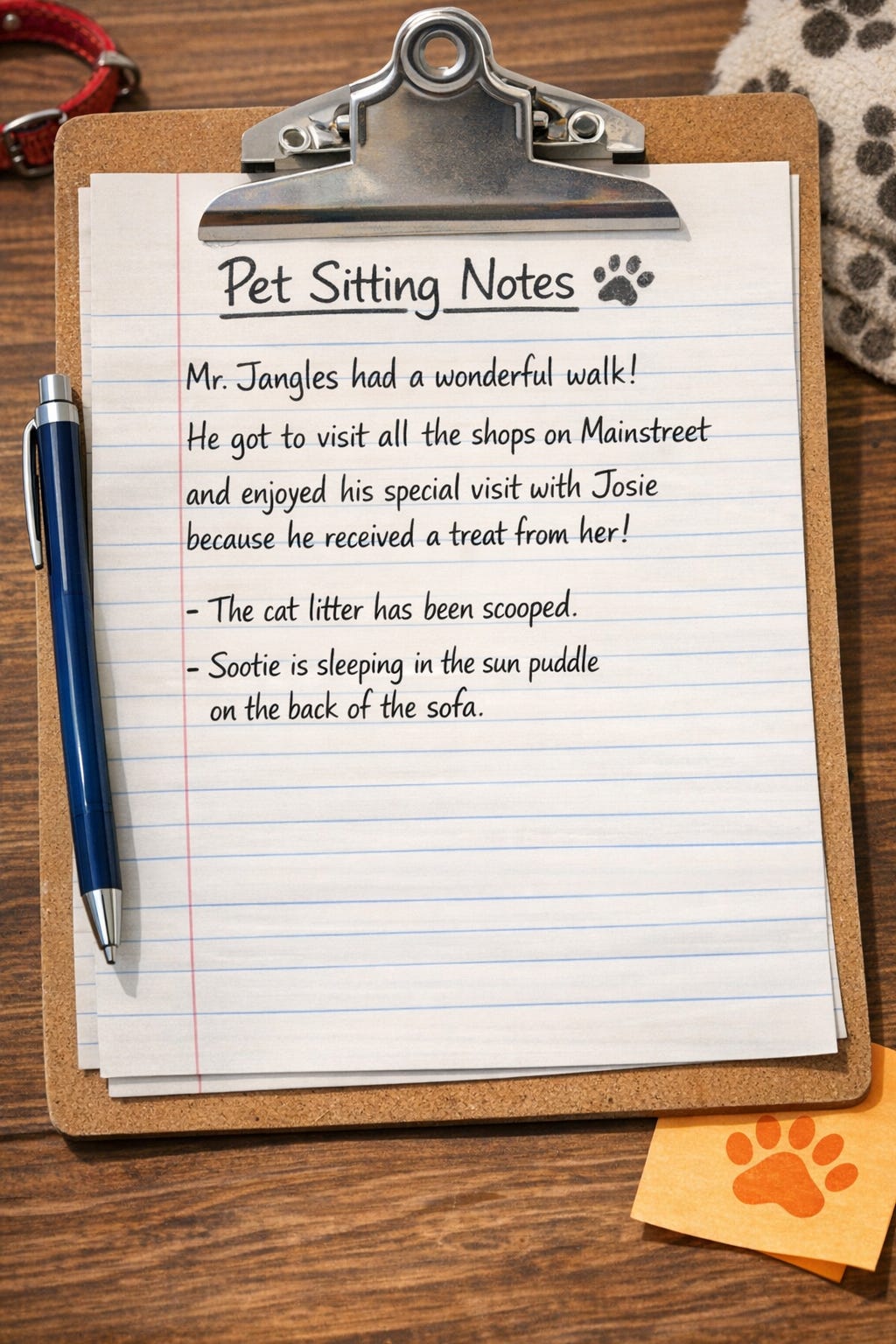
When I launched my little pet sitting business way back in 2009, it wasn’t with a smartphone. In fact, my phone barely knew how to text. You had to tap the keys, multiple time to even get to the letter you wanted. Texting and photos were considered a luxury service add-on because data was so expensive. Schedules lived in Google Calendar and on the refrigerator, held in place with magnets.
Professional United Pet Sitters (PUPS) offered a bulletin board for messages and a few basic templates for contracts and visit logs you could download. And clients had no idea what happened during a visit, dog walk, or weeklong vacation until they came home and read the handwritten visit sheet. I cannot even imagine a pet owner doing that today. Gosh—it feels like yesterday.
One of my very first clients found me through a small local luxury service newsrag called Mimi’s. I took out a $20 ad. The copy was completely DIY, and the booking that followed more than paid for the expense. My entry price point was a whole $12. Randy was a ragdoll with heart problems and chronic constipation issues, and caring for him required attention, observation, and judgment even back then.
At the time, it was common for cat sitters to “have to” walk dogs to make the financials work. So a slow but steady dog-walking base grew naturally along that corridor of care. Most of those dogs stayed with me for many, many years. Every one of them got their exercise, and I quickly learned something important: people who booked dog walkers often had dogs who needed a bit of leash-polish training. That realization shaped my thinking early, if I ever wanted to grow beyond myself, safety could never depend solely on individual handling skill. Systems would matter. Systems for training both the team member, risk assessments for clients at onboarding, and risk assessments for the dogs themselves.
Competition could be fierce back then. A poop-scooping business owner would call me every few weeks to “network,” until the conversation finally turned and I explained that I wasn’t trying to build a huge company—just a good company. He never called me again. Me, or access to my clients, wasn’t worth his time.
Looking back, that moment feels less personal and more instructive. It exposed an early divide in how success was being defined. Growth meant different things to different people. For some, value was measured in reach and volume. For me, it lived in continuity, judgment, and care done well enough that clients stayed—sometimes for years.
Defining “Professional” Then and Now
Those early reviews often appeared on Angie’s List, and the word professional surfaced again and again. At the time, that didn’t surprise me. Coming from a prior professional and business career, professionalism wasn’t something I aspired to later—it was baked into the bones of the company from the start.
And yet, as I look back at those same reviews now—describing Finicky Feline & Fido, LLC as “very professional”—I feel a quiet dissonance. Not because they were wrong, but because so much has changed since then. The work has changed. The skill sets have grown. Technology entered the picture. Credentialing exploded as the effort to professionalize pet sitting accelerated.
What once qualified as professional would be insufficient today, not due to lack of care or intention, but because the scope of responsibility has deepened.
Still, we use the same word.
That’s the place I keep returning to: as an industry, we’ve never fully revisited what “professional” is meant to mean as the work itself has evolved.
If I was professional in 2009—and nothing about that definition ever needed to change—then professionalism becomes a static label rather than a living standard. Something we earn once, instead of something that matures alongside risk, trust, and responsibility.
That doesn’t mean the work back then wasn’t professional. It means the work now asks more of us, and our shared language hasn’t always kept pace.
Not All Frustration Is Burnout
Sometimes it’s the moment when your work has grown deeper—in judgment, presence, emotional labor, and responsibility—but the role, pricing model, and cultural expectations around you have stayed anchored in an earlier version of the job.
In other fields, this kind of tension is sometimes described as structural dissonance—the strain that arises when a professional’s values, judgment, and sense of responsibility outgrow the systems meant to support the work. It’s not a failure of resilience or mindset. It’s what happens when evolving care is asked to live inside frameworks that were never designed for its current depth.
That gap doesn’t always show up as exhaustion. Often, it shows up as dissonance, especially for solo sitters and long-form caregivers whose work has quietly become relationship-based care while the industry still frames it in minutes, time blocks, or coverage.
The rise of gig platforms didn’t create this gap, but it made it more visible. Time became the dominant unit of care. Coverage replaced continuity.
For many pet owners encountering professional pet care for the first time, those frameworks became the default lens. Minutes are easy to price. Tasks are easy to list. Presence, judgment, and responsibility are not.
Even businesses that intentionally distance themselves from app culture can still inherit parts of that structure, simply because it’s the most readily available model. Without deliberate effort, those frameworks can quietly flatten a work that is anything but simple.
Growth, Scale, and Continuity
Conversations about growth often focus on whether a business can operate without its owner. That’s a reasonable question, but it isn’t the only one that matters. Another question deserves equal attention: how responsibility is held as work becomes distributed.
In most professions, leadership doesn’t mean disappearing from the work. It means deeper accountability for outcomes, culture, training, continuity, and risk.
I’ve been wrestling with this personally for years. It’s one of the reasons I moved away from defining my work in minutes and time blocks and toward outcome-based care. Because so much of what long-form and solo caregivers actually provide isn’t “thirty minutes.” It’s stability. Continuity. Observation. Environmental awareness. Advocacy. Trust.
The work becomes presence-based, not transactional. And when the identity and pricing frameworks don’t shift alongside that reality, the weight of the mismatch lands squarely on the sitter.
If We Want the Public to Understand This Profession Differently...
If we want the public to understand this profession differently,
we have to start by understanding it differently ourselves.
That means acknowledging that professionalism isn’t something we declared finished years ago. It’s something that should deepen as the work deepens. It should expand as responsibility expands. And it should be reflected not just in branding or credentials, but in how care is structured, supported, and sustained over time.
Professionalism isn’t the veneer we place on top of pet care.
It’s the stewardship of the work itself, the outcomes we protect, the boundaries we hold, the continuity we maintain, and the dignity we extend to the people
who choose to practice this as a career.
And that more than scale, systems, or optics is where the future of this profession will either deepen… or quietly fracture.
Reflection Questions for Pet Care Professionals
When you think back to your early years in pet care, what did professional mean to you then—and in what ways has the work quietly required you to expand that definition over time?
Which parts of your current work feel most invisible or hardest to explain in minutes, tasks, or checklists, yet matter most to the outcomes you’re responsible for?
Where do you notice tension between how your care is structured or priced and the level of judgment, presence, and responsibility the work now asks of you?
How do you personally mark growth in your professionalism today—through credentials, systems, boundaries, decision-making, or something less tangible?
If professionalism were treated as an evolving practice rather than a label, what support, language, or structural changes would help you carry this work more sustainably?
For professional standards and safety resources, visit Pet Sitters International.
Beth, Thank you for taking us on a deep dive into the heart and soul of this work.
A dear client dropped by over the holidays with homemade granola & a sweet gratuity card. As she was leaving, she asked me if we could make a date for me to come over and teach her how to play with Milo The Kitty. 🦁😭 So I did. There is no price to put on this.
It is one of my most cherished gifts.